
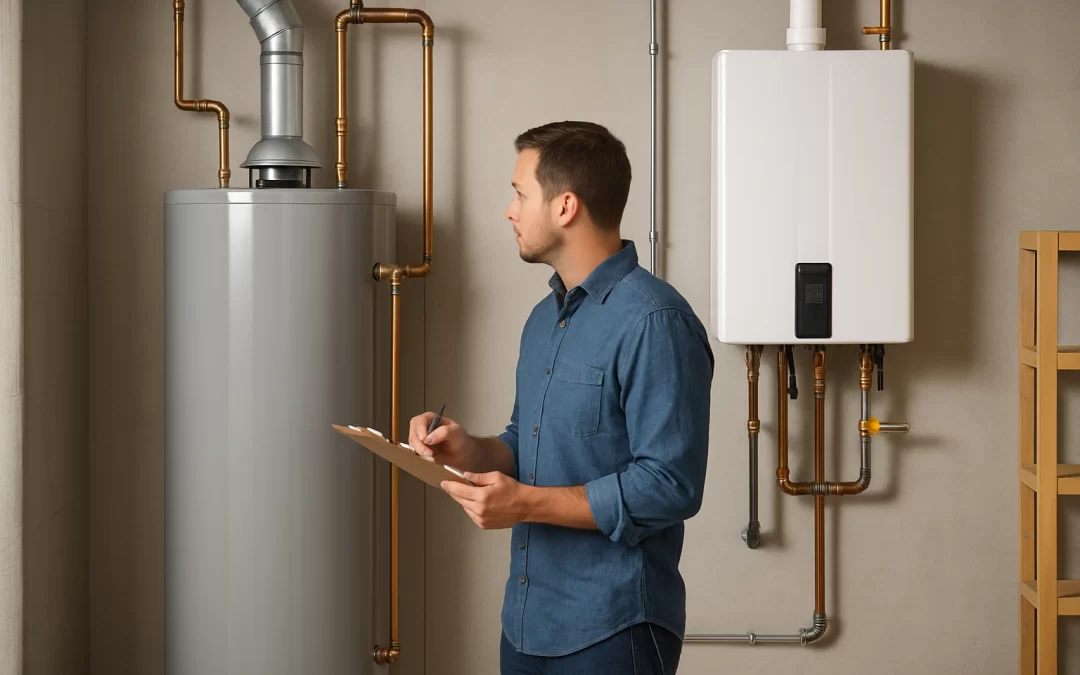
Tankless vs. traditional water heaters mainly differ in how they heat water and how they impact your bills. A tankless unit can cut water heating costs by about 10–30% for many homes, but it usually costs 2–3 times more upfront than a basic tank. Traditional tank heaters are cheaper to install but waste money keeping water hot all day. The tradeoff: tankless saves more over time, while a tank is cheaper today but often more expensive over the life of the system.
This guide is for homeowners and renters who pay the utility bills and want to lower monthly costs without getting lost in technical details. Water heating is often the second-largest energy use in a home, so choosing the right system can free up real money every month. We’ll compare tankless vs. traditional water heaters in plain language, focusing on energy savings, upfront cost, and long-term value. You’ll also see when it makes sense to spend more now to save more later—and when it doesn’t.
Table of Contents
- Causes of High Water Heating Costs
- Common Overspending Behaviors
- What to Check First Before Replacing a Heater
- Immediate Savings Without a Full Replacement
- Long-Term Savings and Upgrade Options
- When Spending More Actually Saves More
- Common Costly Mistakes to Avoid
- When to Hire a Professional
- Decision Guide: Tankless vs. Traditional
- Frequently Asked Questions
- Summary and Next Steps
Causes of High Water Heating Costs
Water heaters use energy every time you run hot water—and, in the case of traditional tanks, even when you don’t. Understanding what drives costs helps you see where tankless vs. traditional systems differ.
How Traditional Tank Water Heaters Drive Up Costs
A traditional water heater stores 30–80 gallons of hot water in a tank and keeps it hot 24/7. This creates “standby losses,” meaning you pay to reheat water that cools down while just sitting there.
- Constant reheating: The burner or heating element cycles on and off all day.
- Heat loss through the tank walls: Even insulated tanks slowly lose heat.
- Oversized tanks: Many homes have larger tanks than they truly need, increasing losses.
For a typical household, water heating can be 15–20% of the energy bill. With an older, inefficient tank, that share can be even higher.
How Tankless Water Heaters Affect Costs
Tankless (on-demand) water heaters heat water only when you turn on a hot water tap. There’s no large tank of water being kept hot all day.
- No standby losses: Energy is used only when hot water is needed.
- Higher efficiency: Many gas tankless units reach 90%+ efficiency, especially condensing models.
- Right-sized output: They are sized for flow rate (gallons per minute) instead of storage volume.
Because of this, tankless systems can cut water heating energy use by roughly 10–30% compared with a standard tank, depending on your usage and fuel type.
Common Overspending Behaviors
Many households overpay for hot water simply because of habits and outdated equipment, regardless of whether they have tankless or traditional systems.
- Keeping the temperature too high: Many heaters are set at 140°F by default, which wastes energy and increases scald risk. For most homes, 120°F is enough.
- Ignoring sediment buildup: Hard water causes mineral buildup in tanks and tankless units, making them work harder and use more energy.
- Long, frequent hot showers: Even efficient heaters can’t offset very heavy hot water use.
- Running small loads in hot water: Using hot water for small laundry loads or partial dishwasher loads adds up.
- Delaying replacement of very old units: A 15–20-year-old tank heater can be far less efficient than a modern one, especially if it’s never been maintained.
These behaviors can easily add $10–$30 per month to your bill, regardless of heater type. Fixing them is often cheaper than replacing the heater right away.
What to Check First Before Replacing a Heater
Before choosing between a tankless vs. traditional water heater, it’s smart to confirm whether replacement is truly needed and what’s driving your costs.
1. Age and Condition of Your Current Heater
- Gas or electric tank: Typical life span is 8–12 years.
- Tankless: Often 15–20 years with proper maintenance.
If your tank heater is over 10 years old, replacement planning is wise. If it’s under 7–8 years and working well, upgrades and maintenance may be more cost-effective in the short term.
2. Your Energy Source and Rates
Costs and savings depend heavily on whether you use natural gas, propane, or electricity.
- Natural gas: Often cheaper per unit of energy than electricity in many areas.
- Electricity: Can be more expensive, but electric heat pump water heaters are very efficient.
- Propane: Usually more expensive than natural gas, so efficiency gains matter more.
Check your utility bills to see how much you currently spend on gas or electricity for water heating (if itemized) or estimate based on total usage.
3. Hot Water Usage Patterns
How and when your household uses hot water affects which system is best.
- Large families with overlapping showers may need higher flow rates or multiple tankless units.
- Smaller households often benefit more from tankless because standby losses are a bigger share of total use.
- Vacation homes or part-time occupancy favor tankless, since you’re not paying to keep water hot when you’re away.
Immediate Savings Without a Full Replacement
If your current heater is still serviceable, there are low-cost steps that can cut your bills right away, whether you have a tankless or traditional system.
Lower the Temperature Setting
Most homes can safely set water heater temperature to about 120°F.
- Potential savings: Around 4–10% off water heating costs for every 10°F reduction.
- Monthly impact: Often $3–$10 per month, depending on usage and energy rates.
This is a simple DIY adjustment on most units. Always follow the manufacturer’s instructions.
Add Insulation (Tank Heaters)
For traditional tank heaters, reducing heat loss can be very cost-effective.
- Water heater blanket: $20–$50; can save $2–$7 per month on older, poorly insulated tanks.
- Pipe insulation: $10–$30; reduces heat loss in the first few feet of hot water piping.
These upgrades often pay for themselves in under 1–2 years, especially on older tanks located in unheated spaces like garages or basements.
Fix Leaky Faucets and Showerheads
Even a small hot water leak wastes both water and energy.
- Cost: Often under $20 in parts for basic repairs.
- Savings: A slow drip can waste hundreds of gallons per year, adding a few dollars per month to your bill.
Install Low-Flow Fixtures
Low-flow showerheads and faucet aerators reduce hot water use without a noticeable comfort loss for most people.
- Cost: $10–$40 per fixture.
- Savings: $5–$15 per month in combined water and energy for a typical family.
Long-Term Savings and Upgrade Options
When your current heater is near the end of its life or failing, you’ll need to decide between another traditional tank or a tankless water heater. Long-term savings depend on the type, efficiency, and your usage.
Upfront Costs: Tankless vs. Traditional
Typical installed costs (these vary by region and home layout):
- Standard gas tank (40–50 gallon): About $1,000–$2,000 installed.
- High-efficiency gas tank: About $1,500–$3,000 installed.
- Gas tankless: About $2,000–$4,500 installed (more if major gas line or venting upgrades are needed).
- Electric tank: About $900–$1,800 installed.
- Electric tankless: About $1,500–$3,000 installed, but may require electrical panel upgrades.
Tankless units usually cost more upfront, mainly due to installation complexity and equipment cost.
Monthly Savings Estimates
Actual savings depend on energy prices and usage, but here are typical ranges when switching from an older standard tank to a new tankless unit:
- Gas tank to gas tankless: Savings of about $8–$25 per month for many households.
- Electric tank to electric tankless: Savings of about $5–$20 per month, depending on rates.
- Old inefficient tank to new efficient tank: Savings of about $5–$15 per month.
Smaller households and vacation homes often see higher percentage savings with tankless because they avoid paying to keep water hot when it’s not used.
Payback Period: When Does Tankless Pay Off?
To estimate payback, compare the extra upfront cost of tankless vs. the monthly savings.
- If a tankless system costs $1,500 more upfront than a standard tank and saves $15 per month, simple payback is about 8–9 years.
- If it saves only $8 per month, payback stretches to around 15+ years, which may be close to the unit’s life span.
In high energy cost areas or with heavy hot water use, payback can be faster. In low-cost energy areas or with light use, the financial benefit may be modest.
Other Long-Term Benefits
- Longer life span (tankless): Often 15–20 years vs. 8–12 for tanks, which can reduce replacement frequency.
- Space savings: Tankless units free up floor space, which can matter in smaller homes.
- Endless hot water (within capacity): No running out mid-shower, which is a comfort benefit rather than a direct savings.
When Spending More Actually Saves More
Sometimes, paying more upfront for a tankless or high-efficiency traditional heater makes clear financial sense. Other times, it doesn’t.
Good Candidates for Tankless Water Heaters
Tankless often makes financial sense when:
- You have high energy costs (especially propane or high electric rates).
- Your household uses moderate amounts of hot water spread throughout the day.
- Your current heater is old, inefficient, or failing, so you must replace it anyway.
- You plan to stay in the home for 10+ years and can benefit from long-term savings.
In these cases, the combination of lower monthly bills and longer life span can justify the higher upfront cost.
When a Traditional Tank Is the Smarter Financial Choice
A standard or high-efficiency tank may be better when:
- You’re on a tight budget and need the lowest upfront cost.
- You expect to move within 5–7 years, so you won’t fully benefit from long payback periods.
- Your home would need costly upgrades (gas line, venting, or electrical panel) to support tankless.
- Your energy rates are relatively low, so monthly savings from tankless would be small.
In these situations, a well-chosen, efficient tank heater plus simple efficiency upgrades can be the best value.
Common Costly Mistakes to Avoid
Whether you choose tankless or traditional, avoiding these mistakes can save you hundreds or even thousands over time.
- Oversizing the system: Buying a much larger tank or higher-flow tankless than you need increases upfront cost and can reduce efficiency.
- Ignoring maintenance: Skipping annual flushing or descaling shortens life span and increases energy use.
- Choosing the wrong fuel type without checking rates: Switching from gas to electric (or vice versa) without comparing local prices can raise your bills.
- DIY installation without proper knowledge: Mistakes with gas, venting, or electrical work can be dangerous and may void warranties or insurance coverage.
- Not checking rebates or incentives: Many utilities offer rebates for efficient water heaters, which can significantly reduce upfront cost.
A bit of planning—checking your actual needs, local energy prices, and available incentives—can prevent expensive regrets.
When to Hire a Professional
Some water heater tasks are DIY-friendly, but others are best left to licensed professionals for safety, code compliance, and long-term reliability.
DIY-Friendly Tasks
- Lowering the thermostat setting (following the manual).
- Insulating hot water pipes and, in many cases, adding a water heater blanket to older tanks.
- Replacing showerheads and faucet aerators with low-flow models.
- Basic leak checks and minor faucet repairs.
When to Call a Professional
- New installation or full replacement: Especially for gas or electric tankless units.
- Gas line or venting changes: These must meet local codes and safety standards.
- Electrical panel upgrades: Often needed for electric tankless units.
- Recurring pilot light issues, gas smells, or electrical problems: These can be safety hazards.
A qualified plumber or HVAC contractor can also help you size the system correctly and estimate real-world savings for your home.
Decision Guide: Tankless vs. Traditional
Use this section to decide whether to act now or later, and which type of water heater fits your situation best.
Do Now vs. Do Later
- Act now if your heater is leaking, over 10–12 years old (tank), or frequently failing. Emergency replacements often cost more, so planning ahead can save money.
- Wait and plan if your heater is under 8 years old, working reliably, and your bills are reasonable. Focus on low-cost efficiency steps first.
Quick Fix vs. Investment
- Quick fixes: Lowering temperature, adding insulation, fixing leaks, and upgrading fixtures. These are low-cost and pay back quickly.
- Investment: Replacing the entire heater with a tankless or high-efficiency tank. Higher upfront cost but larger long-term impact.
DIY vs. Professional
- DIY: Simple adjustments and add-ons that don’t involve gas or major electrical work.
- Professional: Any full replacement, tankless installation, or work involving gas lines, venting, or electrical panels.
Cheap Fix vs. Full Upgrade
Consider these questions:
- Is your current heater near the end of its life? If yes, a full upgrade often makes more sense than sinking money into repairs.
- Do you plan to stay in the home long-term? If yes, a tankless or high-efficiency tank can pay off over time.
- Would a tankless installation require major home upgrades? If yes, compare those costs carefully against expected savings.
If the extra cost of tankless plus any required upgrades will not be recovered within the time you plan to stay in the home, a quality traditional tank is usually the better financial choice.
Frequently Asked Questions
How much can I really save with a tankless water heater?
Most households switching from an older standard tank to a gas tankless unit save about 10–30% on water heating energy. In dollar terms, that’s often around $8–$25 per month. Your actual savings depend on local energy prices, how much hot water you use, and how inefficient your old heater was.
Is a tankless water heater worth it for a small household?
For one- or two-person households, tankless can make sense because you avoid paying to keep a big tank of water hot all day. However, if your energy rates are low and your existing tank is still in good shape, the savings may be modest compared with the higher upfront cost. In that case, waiting until your current heater is near the end of its life can be smarter.
Do tankless water heaters increase home value?
They can be a selling point, especially in markets where buyers value efficiency and modern systems. While you may not recover the full cost in resale value alone, the combination of lower utility bills and improved appeal can help. If you plan to sell soon, a new efficient tank may offer a better balance of cost and return.
What’s the biggest downside of tankless water heaters?
The main downside is the higher upfront cost, especially if your home needs gas line, venting, or electrical upgrades. Some homes also find that a single tankless unit can struggle with multiple high-demand uses at once (like two showers plus a dishwasher), so proper sizing is critical.
Should I replace my water heater before it fails?
Replacing proactively when your tank is around 10–12 years old can save money and stress. Emergency replacements often limit your choices and can cost more in rush labor and less competitive pricing. Planning ahead lets you compare tankless vs. traditional options calmly and take advantage of rebates.
Are there rebates for efficient water heaters?
Many utilities and local programs offer rebates for high-efficiency tank and tankless water heaters, especially gas condensing and heat pump models. These incentives can reduce upfront costs by $100–$500 or more. Check your utility’s website or local energy efficiency programs before you buy.
Summary and Next Steps
Tankless water heaters can offer meaningful energy savings and longer life, but they come with higher upfront costs and may require home upgrades. Traditional tank heaters are cheaper to install and can still be efficient, especially when paired with simple low-cost improvements. The best choice depends on your budget, how long you’ll stay in your home, your energy rates, and your hot water habits.
To move forward:
- Check the age and condition of your current heater and lower the temperature to around 120°F if it’s higher.
- Add insulation and low-flow fixtures to capture easy savings right away.
- Get quotes for both tankless and traditional replacements, including any needed upgrades, and compare total costs vs. estimated monthly savings.
- Look for rebates and incentives from your utility or local programs to reduce upfront costs.
For more ways to cut home energy costs and choose upgrades that truly pay off, explore additional guides on BestHomeSavings.com, such as resources on lowering utility bills and planning cost-effective home improvements. Taking a few informed steps now can keep your hot water reliable while putting more money back in your pocket each month.