
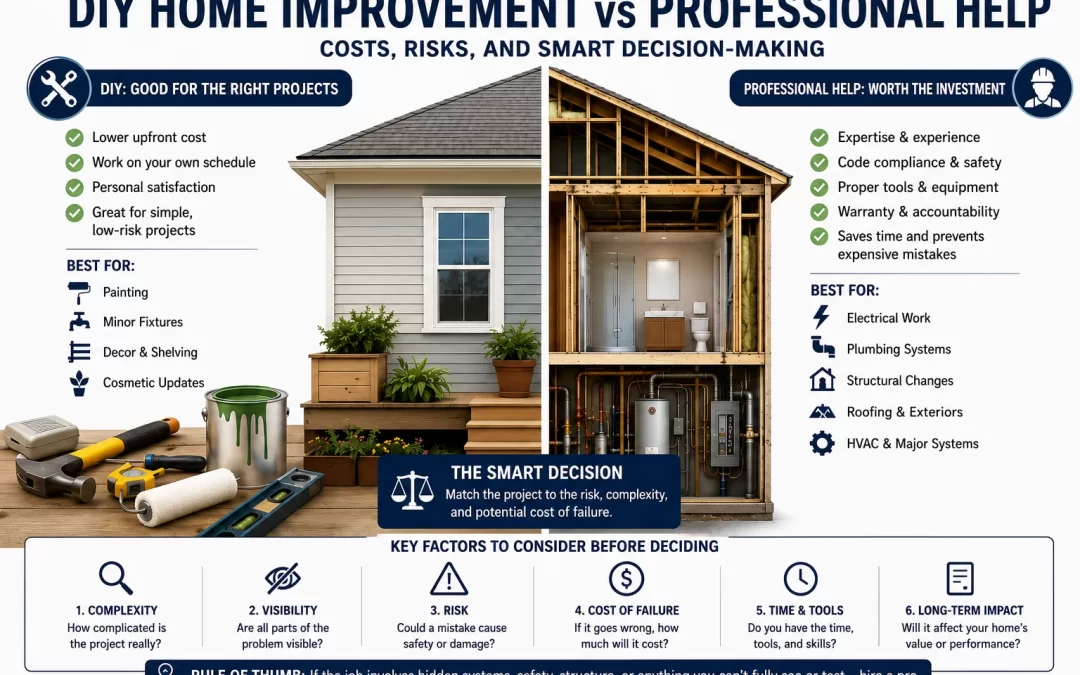
DIY home improvement is not a cheaper version of professional work—it is a risk assumption model where the homeowner absorbs diagnostic uncertainty, execution responsibility, and correction cost in exchange for reduced upfront labor expense.
The critical reality most homeowners miss is this: the decision is not about skill or effort—it is about whether the system involved can tolerate error without producing exponential repair costs.
Once a project involves hidden systems, structural load, or safety exposure, the decision is no longer optional in practical terms—it becomes a risk classification problem rather than a preference choice.
Table of Contents
- How DIY vs Professional Work Actually Differs
- Project Complexity Tiers
- Real Cost Comparison: DIY vs Hiring a Pro
- Risk Structure: Where DIY Fails Most Often
- Tools, Skills, and Hidden Cost Factors
- Decision Framework (When to DIY vs Hire)
- Common Decision Mistakes
- FAQ
- Key Takeaways
How DIY vs Professional Work Actually Differs
DIY and professional home improvement are separated by a single structural boundary: who absorbs system uncertainty before the outcome is known.
- DIY work: converts labor savings into exposure to diagnostic error, tool limitations, and correction risk
- Professional work: converts higher upfront cost into controlled execution, accountability, and risk containment
The tradeoff is not money versus effort—it is predictable cost versus unmanaged uncertainty.
Most expensive outcomes occur when homeowners attempt to apply execution-based thinking to systems that are fundamentally diagnostic in nature.
In those systems, the visible task is not the problem—the hidden condition behind it is.
Project Complexity Tiers
Home improvement tasks can be reduced to three functional complexity states based on system visibility and failure consequence:
- Low complexity: surface-level, reversible work where failure does not propagate beyond the visible layer
- Medium complexity: partial system interaction where hidden variables begin to influence outcomes
- High complexity: hidden infrastructure, structural load, or safety-critical systems where failure propagates across multiple domains
Complexity is not defined by difficulty—it is defined by how many unseen dependencies exist beneath the surface of the task.
The deeper the system dependency chain, the less reliable DIY execution becomes regardless of skill level.
Real Cost Comparison: DIY vs Hiring a Pro
DIY cost analysis fails most often because it excludes the cost of uncertainty resolution.
- DIY reduces labor expense but increases exposure to rework and correction cycles
- Professional work consolidates labor, diagnosis, and liability into a single priced outcome
- Tool acquisition and learning time function as hidden cost multipliers in DIY scenarios
The lowest-cost option is not the lowest upfront price—it is the option with the lowest probability of corrective intervention.
Once a project enters hidden-system territory, DIY savings shrink rapidly due to compounding risk of misdiagnosis.
Risk Structure: Where DIY Fails Most Often
DIY failure is not random—it clusters in systems where outcomes depend on invisible conditions rather than visible execution.
- Electrical systems where wiring condition cannot be fully observed before intervention
- Plumbing systems where leaks originate behind finished surfaces
- Structural modifications where load distribution is not visually apparent
- Roofing systems where sealing integrity determines long-term failure behavior
The core failure mode is not execution error—it is incorrect system diagnosis before work begins.
Once the wrong assumption is embedded, even correctly executed DIY work produces long-term failure.
Tools, Skills, and Hidden Cost Factors
DIY outcomes depend on three underestimated variables that are typically excluded from cost comparisons:
- Tool precision and availability
- Technical accuracy in diagnosing system state
- Time capacity for iteration and correction
Most DIY budgets collapse because they assume execution is the primary cost, when in reality diagnosis and correction dominate total expenditure in complex systems.
Professional services compress these variables into a controlled output, removing uncertainty from the cost equation.
Decision Framework (When to DIY vs Hire)
The correct decision model is not preference-based—it is failure tolerance-based.
- Safe for DIY: low-risk, fully visible, reversible cosmetic or surface tasks with isolated impact
- Conditional DIY: moderate systems with predictable behavior and limited hidden dependencies
- Professional required: any system where failure affects safety, structure, or hidden infrastructure
If a failure cannot be fully observed during execution, DIY becomes a probabilistic risk rather than a controlled process.
In those cases, professional intervention is not a premium option—it is risk containment.
Common Decision Mistakes
- Assuming visible simplicity reflects system simplicity
- Underestimating hidden system dependencies
- Excluding correction cost from DIY calculations
- Choosing professional help only after DIY failure occurs
- Confusing familiarity with competence in unfamiliar systems
Most cost overruns are not caused by labor rates—they are caused by incorrect system classification at the decision stage.
FAQ
Is DIY home improvement always cheaper?
No. DIY is only cheaper when both diagnostic certainty and execution reliability are high. In complex systems, correction costs often exceed professional pricing.
What home improvement tasks are safe to DIY?
Tasks that are surface-level, reversible, and do not depend on hidden systems—such as painting or simple cosmetic upgrades.
When should I hire a professional?
When the system involves electrical, plumbing, structural, or hidden infrastructure where failure consequences extend beyond the visible work area.
Can DIY increase home value?
Yes, but only when execution quality meets professional standards and does not introduce hidden defects that reduce long-term value.
Key Takeaways
DIY home improvement is a controlled approach only in low-complexity environments. As system depth increases, uncertainty grows faster than skill can compensate, shifting the decision from cost optimization to risk containment.
The true decision boundary is not DIY versus professional work—it is whether the system allows errors without cascading financial and structural consequences.