
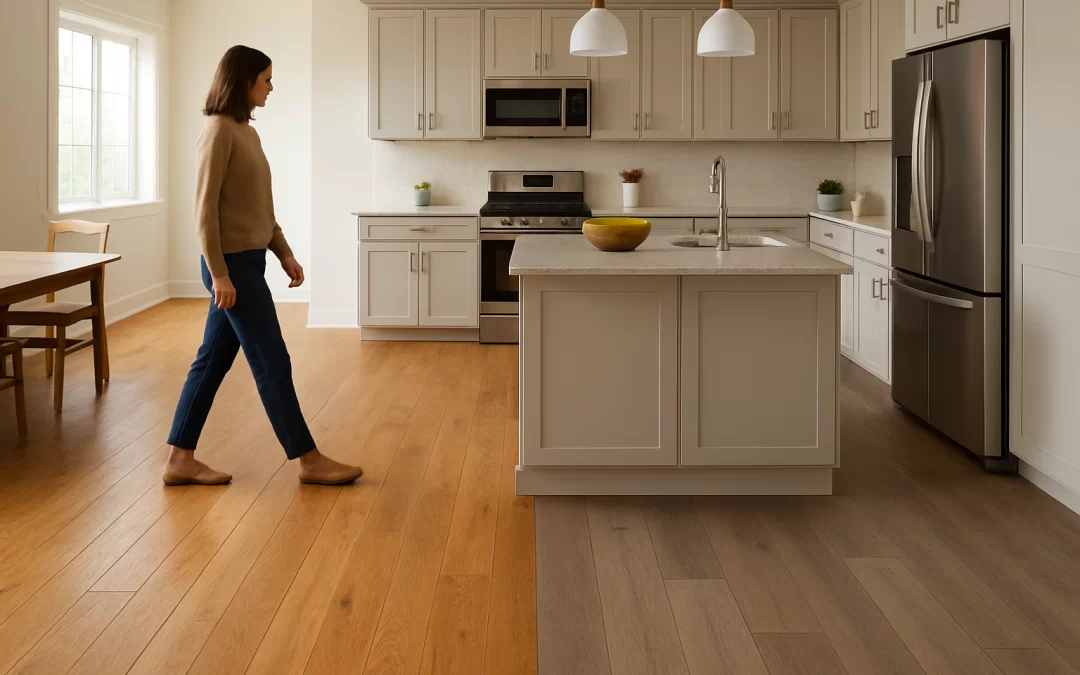
Hardwood vs. vinyl plank kitchen flooring comes down to cost, durability, and how much maintenance you’re willing to handle. Vinyl plank usually costs 40–70% less upfront and can save $10–$40 per month in avoided repairs and refinishing, especially in busy kitchens. Hardwood can add more resale appeal, but it’s easier to damage with water and requires costly refinishing. The tradeoff: hardwood offers long-term style and value, while vinyl plank usually wins on total cost of ownership for most everyday kitchens.
This guide is for homeowners and renters comparing hardwood and vinyl plank specifically for kitchens, where spills, moisture, and heavy traffic are daily realities. Kitchen flooring is a big-ticket decision that can easily swing thousands of dollars either way. By understanding true costs, durability, and maintenance, you can avoid overspending and choose the option that fits your budget, lifestyle, and long-term plans.
Table of Contents
- Major Cost Drivers in Kitchen Flooring
- Common Ways People Overspend on Kitchen Flooring
- What to Check First Before Choosing Hardwood or Vinyl Plank
- Immediate Savings: How to Cut Flooring Costs Right Now
- Long-Term Savings and Upgrades
- When Spending More Actually Saves You Money
- Common Costly Mistakes with Kitchen Flooring
- When to Hire a Professional vs. DIY
- Cost & Savings Breakdown: Hardwood vs. Vinyl Plank
- Decision Guide: Timing, DIY, and Upgrade Choices
- Frequently Asked Questions
- Summary & Next Steps
Major Cost Drivers in Kitchen Flooring
The cost difference between hardwood and vinyl plank kitchen flooring is driven by more than just the price per square foot. Understanding these drivers helps you avoid surprise expenses and pick the material that fits your budget over the full life of the floor.
1. Material Cost per Square Foot
- Hardwood (site-finished or prefinished): Typically $6–$15 per sq. ft. for material alone, depending on species (oak, maple, walnut), grade, and finish.
- Luxury vinyl plank (LVP/LVT): Typically $2–$6 per sq. ft. for quality products suitable for kitchens.
For a 200 sq. ft. kitchen, that’s roughly $400–$1,200 for vinyl plank vs. $1,200–$3,000+ for hardwood just in materials.
2. Installation Labor
- Hardwood: $4–$8 per sq. ft. for professional installation, more if the floor needs sanding and finishing on site.
- Vinyl plank: $2–$4 per sq. ft. for professional installation; many products are DIY-friendly click-lock systems.
Labor can double your total cost with hardwood, especially if your subfloor needs work.
3. Subfloor Preparation and Leveling
Both hardwood and vinyl plank need a solid, level base, but hardwood is less forgiving.
- Hardwood often requires:
- Thicker, more stable subfloor
- Moisture barriers in some homes
- More extensive leveling
- Vinyl plank can often go over:
- Existing tile or vinyl (if flat and secure)
- Less-than-perfect subfloors with minor prep
Subfloor work can add $300–$1,000+ to a typical kitchen project, especially with hardwood.
4. Maintenance and Repair Costs
- Hardwood:
- Refinishing every 7–15 years: $3–$6 per sq. ft. ($600–$1,200 for a 200 sq. ft. kitchen)
- Spot repairs for water damage or deep scratches
- Vinyl plank:
- Usually no refinishing
- Individual plank replacement if damaged (often DIY)
Over 15–20 years, hardwood’s maintenance can add thousands to your total cost, while vinyl plank’s costs are usually minimal.
Common Ways People Overspend on Kitchen Flooring
Many homeowners pay more than necessary for kitchen flooring because they focus on the wrong things or underestimate hidden costs.
1. Choosing Hardwood for a High-Moisture, High-Spill Kitchen
In busy households with kids, pets, or frequent cooking, hardwood can be damaged by repeated spills, leaks, and steam. This leads to:
- Warping or cupping boards
- Stains that require sanding
- Early refinishing or partial replacement
Those repairs can easily add $200–$500 every few years, wiping out the value of choosing hardwood for “durability.”
2. Paying for Premium Hardwood Where Vinyl Would Perform Just as Well
Many people install high-end hardwood in a kitchen mainly for looks, even when a quality vinyl plank can mimic the same style at half the cost.
- Upgrading from mid-range vinyl to premium hardwood can add $3,000–$5,000+ to a full kitchen remodel.
- In many markets, buyers can’t easily tell the difference at a glance, especially with modern vinyl designs.
3. Ripping Out a Solid Subfloor Unnecessarily
Some installers recommend full tear-out of existing flooring or subfloor when a floating vinyl plank system could go right over it.
- Unnecessary demo and disposal can add $500–$1,500 to your project.
- Always ask if your existing floor can be used as a base for vinyl plank.
4. Ignoring the Rest of the Kitchen Budget
Overspending on flooring can force you to cut back on higher-impact upgrades like cabinets, lighting, or appliances. For example:
- Choosing hardwood over vinyl plank might use up $2,000–$4,000 that could have gone toward energy-efficient lighting or better appliances, which can reduce monthly utility bills.
If you’re planning a broader remodel, it’s worth reviewing a full kitchen remodel cost guide so flooring doesn’t crowd out more valuable improvements.
What to Check First Before Choosing Hardwood or Vinyl Plank
Before you pick a material, a few quick checks can prevent expensive surprises and help you choose the right floor for your kitchen.
1. Moisture and Leak Risk
- Check under the sink, around the dishwasher, fridge, and near any exterior doors for signs of past leaks or water damage.
- If your kitchen is over a crawlspace or slab, ask about moisture levels or past issues.
If you have any history of leaks or high humidity, vinyl plank is usually the safer, cheaper long-term choice.
2. Existing Floor Condition
- Is your current floor level, solid, and free of soft spots?
- Are there multiple layers of old flooring?
A stable, relatively flat floor often means you can install vinyl plank on top, saving $300–$1,000 in demo and prep. Hardwood usually needs more precise leveling and a better-quality subfloor.
3. How Long You Plan to Stay
- Staying 3–7 years: Vinyl plank often makes more financial sense, as you may not live there long enough to benefit from hardwood’s refinishing potential.
- Staying 10–20+ years: Hardwood can be refinished and updated, which may make sense if you value long-term style and are prepared for maintenance costs.
4. Household Lifestyle
- Kids, pets, and heavy cooking usually favor vinyl plank for its scratch and water resistance.
- Lower-traffic, more formal kitchens can handle hardwood better.
Being honest about daily wear and tear can save you hundreds in repairs and refinishing.
Immediate Savings: How to Cut Flooring Costs Right Now
If you’re trying to keep your kitchen flooring project affordable, there are several ways to reduce costs without sacrificing quality.
1. Choose Mid-Range Vinyl Plank Instead of Premium Hardwood
- Switching from $10/sq. ft. hardwood to $4/sq. ft. vinyl plank in a 200 sq. ft. kitchen can save:
- Material savings: About $1,200
- Labor savings: Another $400–$800
- Total immediate savings: $1,600–$2,000+.
2. Limit the Flooring Area
Only replace flooring where it’s visible and heavily used.
- Skip pantries, closets, or under built-in cabinets if the existing floor is sound.
- Reducing your project by 40 sq. ft. at $8–$12 per sq. ft. installed can save $320–$480.
3. DIY Demolition and Disposal
- Removing old vinyl or laminate yourself can save $1–$2 per sq. ft.
- For a 200 sq. ft. kitchen, that’s $200–$400 in immediate savings.
Be careful with older flooring that may contain asbestos; in that case, professional removal is safer and often required.
4. Install Vinyl Plank as a Floating Floor
Many vinyl plank products click together and “float” over the existing floor.
- This can reduce labor costs by $200–$600 compared to glue-down or nail-down systems.
- It also makes future repairs or replacement easier and cheaper.
Long-Term Savings and Upgrades
Flooring affects more than just the upfront cost. It also influences maintenance, durability, and even how other upgrades perform over time.
1. Maintenance and Repair Over 10–20 Years
- Hardwood:
- Refinishing once in 10–15 years: $600–$1,200 for a typical kitchen.
- Spot repairs for water damage: $150–$500 per incident.
- Vinyl plank:
- Occasional plank replacement: often under $100 in materials and can be DIY.
- No refinishing required.
Over 15 years, vinyl plank can easily save $800–$2,000+ in maintenance compared with hardwood in an active kitchen.
2. Durability in Real-World Kitchen Use
- Hardwood:
- Can last 50+ years with proper care and refinishing.
- More vulnerable to dents, scratches, and water damage.
- Vinyl plank:
- Typically rated for 15–25 years of residential use.
- Highly resistant to water, stains, and everyday wear.
In kitchens with frequent spills and heavy traffic, vinyl plank often delivers more “usable years” before looking worn out.
3. Resale Value and Buyer Appeal
- Hardwood is still a strong selling point in many markets, especially in open floor plans where it runs through multiple rooms.
- High-quality vinyl plank is increasingly accepted, especially in kitchens, basements, and rentals.
If you’re planning a broader remodel, consider how your flooring choice fits with other upgrades that impact resale, such as kitchen remodel ROI and cabinet or layout changes.
4. Comfort and Noise
- Hardwood:
- Feels solid and can be refinished to change color or sheen.
- Can be noisier underfoot without rugs or sound underlayment.
- Vinyl plank:
- Softer underfoot and quieter, which can matter in open-concept homes.
- Often more comfortable for long periods of standing while cooking.
When Spending More Actually Saves You Money
Sometimes the cheapest option upfront isn’t the best financial choice over time. In certain situations, paying more for the right material or installation can prevent expensive problems later.
1. Upgrading to Waterproof or High-Quality Vinyl Plank
- Spending an extra $1–$2 per sq. ft. on a waterproof, thicker vinyl plank with a strong wear layer can:
- Reduce the risk of water damage from leaks and spills.
- Extend the life of the floor by 5–10 years.
- On a 200 sq. ft. kitchen, that’s an extra $200–$400 upfront that can prevent a full $2,000–$4,000 replacement later.
2. Paying for Proper Subfloor Prep
Skimping on leveling or moisture barriers can lead to:
- Warped hardwood boards
- Clicking or flexing vinyl planks
- Premature wear and visible seams
Spending $300–$800 on subfloor prep can easily avoid a $2,000+ repair or early replacement.
3. Choosing Hardwood in Open, High-Value Spaces
- If your kitchen flows directly into living and dining areas with existing hardwood, continuing hardwood through the kitchen can:
- Create a seamless look that buyers value.
- Support higher resale prices in some markets.
- In these cases, the extra $2,000–$4,000 for hardwood may be recouped in resale value, especially in higher-end homes.
4. Professional Installation for Complex Layouts
In kitchens with many angles, islands, or transitions to other rooms, professional installation can:
- Prevent gaps, buckling, and uneven transitions.
- Reduce waste from miscuts, saving on material costs.
Paying an extra $400–$800 for skilled labor can avoid visible flaws that hurt both appearance and resale value.
Common Costly Mistakes with Kitchen Flooring
Avoiding a few frequent mistakes can save you hundreds or even thousands of dollars over the life of your floor.
1. Installing Hardwood Without Addressing Moisture
- Skipping moisture testing or barriers over concrete or damp crawlspaces can cause hardwood to warp.
- Fixing this often requires full replacement, costing $3,000–$6,000+.
2. Choosing the Wrong Wear Layer or Finish
- Thin wear layers on vinyl plank or soft hardwood species (like pine) scratch more easily.
- This can make a new floor look worn within a few years, pushing you toward early replacement.
3. Not Accounting for Appliance Height and Clearances
- Adding new flooring without adjusting cabinets or appliances can:
- Trap your dishwasher under the counter
- Cause clearance issues with fridge doors or oven doors
- Fixing this later can cost $200–$800 in labor and adjustments.
4. Over-Improving for the Neighborhood
- Installing top-tier hardwood in a modest home where buyers expect practical finishes can mean you never recoup the extra cost.
- In these cases, mid-range vinyl plank often delivers better value.
5. Poor Planning with Other Remodel Elements
Flooring choices should align with cabinets, layout, and lighting plans.
- Changing your mind after cabinets or islands are installed can lead to:
- Rework and extra labor
- Wasted materials
- Reviewing common kitchen remodel mistakes can help you avoid these cascading costs.
When to Hire a Professional vs. DIY
Deciding between DIY and professional installation affects both upfront cost and long-term performance.
DIY-Friendly Situations
- Vinyl plank, floating installation:
- Simple, rectangular kitchens with few obstacles.
- Existing floor is flat and in good condition.
- Potential savings: $400–$1,000 in labor for a 200 sq. ft. kitchen.
When to Hire a Professional
- Hardwood installation:
- Nail-down or glue-down systems require skill and specialized tools.
- On-site sanding and finishing is not beginner-friendly.
- Complex layouts:
- Multiple doorways, islands, and transitions to other flooring types.
- Subfloor issues:
- Uneven floors, squeaks, or suspected moisture problems.
In these cases, professional work reduces the risk of costly mistakes and premature floor failure.
Cost & Savings Breakdown: Hardwood vs. Vinyl Plank
Here’s a simplified cost and savings comparison for a typical 200 sq. ft. kitchen.
Upfront Costs (Approximate)
- Vinyl Plank (mid-range):
- Material: $2–$4/sq. ft. → $400–$800
- Labor: $2–$3/sq. ft. → $400–$600
- Total: $800–$1,400
- Hardwood (mid-range):
- Material: $6–$10/sq. ft. → $1,200–$2,000
- Labor: $4–$6/sq. ft. → $800–$1,200
- Total: $2,000–$3,200
Upfront savings with vinyl plank: roughly $1,200–$1,800 for a 200 sq. ft. kitchen.
Ongoing Maintenance Costs (10–15 Years)
- Vinyl Plank:
- Minor repairs: $0–$200 total (often DIY).
- Hardwood:
- One refinishing: $600–$1,200.
- Occasional repairs: $150–$500.
- Total: $750–$1,700.
Maintenance savings with vinyl plank: roughly $600–$1,500 over 10–15 years.
Monthly Savings Estimates
When you spread the savings over time, the numbers look like this:
- Upfront savings of $1,200–$1,800 over 10 years:
- Equivalent to about $10–$15 per month.
- Maintenance savings of $600–$1,500 over 10 years:
- Equivalent to about $5–$12 per month.
Combined, choosing vinyl plank over hardwood can effectively save $15–$27 per month over a 10-year period for a typical kitchen.
Payback Period
- If you choose vinyl plank and invest the upfront savings into other efficiency upgrades (like better lighting or appliances), you may see:
- Lower utility bills that help “pay back” your flooring decision in 3–7 years.
- If you choose hardwood for resale value, the “payback” depends on your local market and how long you stay.
When Savings Are Small vs. Significant
- Small savings:
- Choosing between high-end vinyl and low-end hardwood may narrow the cost gap to a few hundred dollars.
- In that case, your decision may lean more on style and resale than pure savings.
- Significant savings:
- Comparing mid-range vinyl to mid- or high-end hardwood in a full kitchen remodel usually saves $1,500–$3,000+.
When It’s Not Worth the Cost
- Paying for premium hardwood in a rental or short-term home rarely pays off.
- Installing hardwood in a kitchen with known moisture issues is usually not worth the risk or repair costs.
Decision Guide: Timing, DIY, and Upgrade Choices
Use this section to decide what to do now, what can wait, and how to balance cost with value.
Do It Now vs. Later
- Do it now if:
- Your current floor is damaged, unsafe, or causing moisture issues.
- You’re already replacing cabinets or changing the kitchen layout.
- Wait if:
- Your floor is worn but functional, and you’re saving for a larger remodel.
- You’re unsure about long-term plans (selling vs. staying).
Quick Fix vs. Investment
- Quick fix (budget-focused):
- Choose mid-range vinyl plank.
- Install over existing floor if possible.
- DIY demo and, if comfortable, DIY installation.
- Investment (long-term, higher budget):
- Choose hardwood if your home and lifestyle support it.
- Invest in professional installation and proper subfloor prep.
- Plan for future refinishing instead of full replacement.
DIY vs. Professional
- DIY is usually best for:
- Floating vinyl plank in simple layouts.
- Homeowners comfortable with measuring, cutting, and basic tools.
- Professional is usually best for:
- Hardwood installation and finishing.
- Uneven or questionable subfloors.
- Complex kitchen layouts or open-concept spaces.
Cheap Fix vs. Upgrade
- Cheap fix:
- Basic vinyl or sheet vinyl can be a low-cost, short-term solution.
- Best for rentals or when you plan to remodel again soon.
- Smart upgrade:
- Quality vinyl plank with a good wear layer offers a strong balance of cost, durability, and appearance.
- Hardwood is a smart upgrade mainly when it matches the rest of the home and your long-term plans.
Frequently Asked Questions
Is vinyl plank cheaper than hardwood for a kitchen?
Yes. For a typical 200 sq. ft. kitchen, vinyl plank usually costs $800–$1,400 installed, while hardwood often runs $2,000–$3,200. Over 10–15 years, vinyl plank also saves on refinishing and repair costs, adding another $600–$1,500 in savings.
Does hardwood add more value to my home than vinyl plank?
In many markets, hardwood can boost resale appeal more than vinyl, especially in higher-end homes and open floor plans. However, in modest homes or rentals, buyers often prioritize condition and style over material, making quality vinyl plank a better value for the cost.
Which is more durable in a busy kitchen: hardwood or vinyl plank?
For everyday spills, pets, and heavy traffic, vinyl plank is usually more durable because it resists water, stains, and scratches better than hardwood. Hardwood can last longer overall but requires more careful maintenance and may need refinishing if heavily worn.
Can I install vinyl plank over my existing kitchen floor?
Often, yes. If your existing floor is flat, secure, and dry, many vinyl plank products can float right over it, saving $300–$1,000 in demo and prep costs. Always follow the manufacturer’s guidelines and address any moisture or structural issues first.
How much maintenance does hardwood need compared to vinyl plank?
Hardwood typically needs refinishing every 7–15 years in a kitchen, plus occasional repairs for scratches or water damage. Vinyl plank usually only needs regular sweeping and mopping, with rare plank replacements, making it much cheaper and easier to maintain over time.
Is it worth paying more for waterproof vinyl plank?
In most kitchens, yes. Spending an extra $1–$2 per sq. ft. on waterproof vinyl plank can prevent costly damage from leaks and spills, potentially avoiding a full floor replacement. Over the life of the floor, this small upfront cost often pays for itself several times over.
Summary & Next Steps
For most kitchens, vinyl plank flooring offers the best balance of cost, durability, and low maintenance, often saving $1,800–$3,000+ over hardwood across installation and long-term care. Hardwood can still be a smart choice in higher-end homes, open layouts, or when you value long-term refinishing and classic appeal, but it comes with higher upfront and ongoing costs.
Before you decide, take a close look at your kitchen’s moisture risk, how long you plan to stay, and your overall remodel budget. Consider whether the money saved by choosing vinyl plank could be better used on other upgrades, like more efficient lighting or smarter kitchen layouts that reduce daily wear and tear. If you’re planning a broader project, it may help to review small kitchen upgrades that save money over time so your flooring choice fits into a cost-effective, long-term plan.
Next steps:
- Measure your kitchen and price out both hardwood and vinyl plank options.
- Inspect your existing floor and subfloor for moisture and levelness.
- Decide whether DIY or professional installation makes more sense for your layout and skill level.
By comparing real costs and thinking about how you actually use your kitchen, you can choose the flooring that saves you the most money over the years while still looking good and standing up to daily life.